
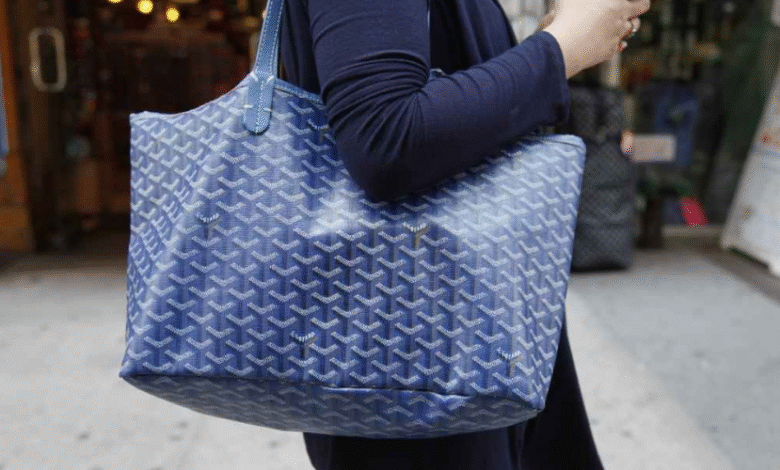
What Makes a Goyard Bag Stand Out in Everyday Life?
There are moments that slide into memory without asking permission small,unremarkable instants that ought to dissolve into the day but refuse to do so.They are not the milestones people post about,nor the occasions marked with speeches or applause. They are fragments:the way a red signal stains water pooling in a gutter;the soft hiss of bus doors folding open and shut the tremor that runs through a row of umbrellas when a crosswind marches down the block.I would have sworn that such moments never last.Yet one evening,after a long day at the office,a stranger’s steadiness at a crowded intersection fixed itself in my mind and would not leave.
The first thing I remember is the rain.It had started as a teasing drizzle around noon and—it must have been in some conspiratorial mood kept finding ways to return just when people had convinced themselves it was over.By the time I stepped outside,the street looked lacquered.Headlights slurred along the asphalt,sirens braided themselves into the noise and a vendor argued gently with a customer about whether his last paper cup could survive one more refill of hot chocolate.I joined the flow toward the crossing where a knot of commuters waited for permission to move,their impatience communicating itself like static.
Everyone seemed late for something,even if that something was only the relief of home.A man shook out one sleeve as if water were the day’s last insult.A woman tried to move an overstuffed tote from one shoulder to the other and winced.Someone muttered into a phone;someone else,soaked past caring,surrendered to the rain and lowered their umbrella altogether.In all that restless choreography,she was still.Coat collar raised,chin level,gaze steady.The bag at her shoulder looked neither new nor precious.It was confident in a quieter way,as if it had learned its job and had no interest in proving anything.
The signal changed.The knot loosened.Bodies slid forward with the street’s oily light turning every step into a small wager.She went with us and then she was gone,swallowed by the evening’s machinery.That should have been the end of it.But later,as I stood in my kitchen waiting for the kettle to decide on a boil,it was her I pictured—not her face,which I cannot convincingly summon—but the way the bag hung at her side and the way her posture created a pocket of calm around her.A detail like that has no right to remain.It remained anyway.
Weeks blurred together in competent,forgettable ways.Deadlines lined up like bus schedules;the weather kept second-guessing itself.I knew nothing about the woman and did not expect to see her again,certainly not in a place that could not have been more different from a rain-glossed corner of the city.But memory,I have learned,is fond of loops.It prefers the rhyme to the straight line.
A Luxury Tote Bag as the Perfect Travel Companion
A friend convinced me to book a short cruise.“You need a longer view,”she said,with the practiced confidence of someone who knows how to prescribe horizons to the overworked.Dawn had only half-committed to the sky when we reached the harbor.The scene felt staged to instruct people in the art of departure:porters speaking in crisp,capable voices;gulls heckling everything from above;a loudspeaker coughing up instructions no one could fully hear.Children tried to drag their suitcases as if they were pets;couples squeezed into photos that swallowed them whole;retirees leaned on railings with the practiced patience of people who have outwaited many kinds of weather.
The ship rose like a neighborhood that had misplaced its ground.Terraces stepped upward in orderly repeats;windows blinked with reflections of early light.Inside,corridors smelled of varnish and detergent;a dining room had already found its clink and murmur;staircases gathered the low tide of conversation in their turns.On deck,the air straightened my posture.The water learned new colors every minute.My friend produced a schedule that read like a friendly dare—buffets,shows,trivia,dancing—and promised we would attend at least three things we did not plan to.
I was at the starboard rail,letting the ship’s slow pivot make a compass of my body,when I saw her.There was no mistaking it.She was the kind of presence the eye recognizes before the mind remembers why.She stood a little down the rail,one hand loose at her side and the other resting on the metal as if listening through it.She did not pose.She did not chase a signal.She looked the way some people read:not only at the surface of a thing,but through it.Draped from her shoulder,familiar and unassuming,was the same Goyard bag.
Recognition altered the weather inside my chest.The softened handles,the canvas that kept its geometry without stiffness,the earned ease of it—everything was as I recalled,except that the memory now had a horizon.Around us,delight practiced itself in public.Families negotiated the physics of fitting everyone into one square of time.A boy told his parents where to stand as if photography were a language he had invented.The coastline unspooled behind us into gray punctuation.She shifted to create space for a couple elbowing toward the rail and the bag rocked once against her hip and settled,the way something sure of its purpose corrects for a small wave without thinking.
Ships rearrange your sense of scale.You recognize the same stranger four times a day and cannot swear you have ever seen your own cabin from the same angle twice.I noticed her in these small refrains:midmorning,at a table on the lee side with a paperback tented in one hand and the other cradling a porcelain cup;afternoon,walking the length of the deck for the plain economy of it;twilight,leaning into a breeze that had decided to sign its name on every sleeve.The bag appeared with her as steadily as breath.It was not costume;it was a travel companion,the kind of luxury tote bag that seemed built for journeys without ever demanding attention.
One evening the loudspeaker found a cheerful voice and invited us to a performance near the bow.Smoke rose from grills;a guitarist negotiated with the wind;children pantomimed patience until patience gave up.My friend and I drifted there with the others.Near the rail we paused;the crowd eddied around us.She stood a few paces away,giving ground when space narrowed,reclaiming it when the current thinned,unbothered by the commerce of attention.The sky attempted every available shade of copper and then,not quite satisfied,invented a few more.A narrow island slid past like a comma the sea had decided to keep.
“You’re somewhere else,”my friend said,half teasing and half correct.
“Just looking,”I answered and it was true in the way a partial truth can be—true about the ocean,true about the small nation of vacationers,true about a woman whose stillness made nearby things feel less hysterical.I wanted to name what drew me,but naming is a way of declaring ownership and the moment resisted that.Perhaps it was the idea that endurance—of an object,of a composure,of a way of being—might itself be a kind of beauty.
Weather experimented with us over the next days.A noon so bright it felt loud;an afternoon that had to be persuaded into continuing;a morning where the horizon sulked under a ceiling of low cloud and the ship’s horn spoke longer than seemed necessary.The shows delivered show-ness;the buffets kept their promises;the gift shop glittered with items designed to translate desire into things.Through it all she was a rumor of a path:a stretch of unhurried walking,a pause at the rail during which nothing obvious occurred,a return to the paperback as if it were a place rather than a book.The bag kept teaching me the small lesson of constancy:that carrying can be quiet.
By the last sunset,people arranged themselves into silhouettes of their better selves.Someone cried without anger,just grief at the day’s refusal to last.The water continued its patient work of remaking a surface into a surface.She rested her elbows on the rail and let the ship do the moving.I stood far enough away to pretend I was looking only at the sea.But what I took with me was smaller:an outline braided to a detail,proof that certain images survive not because they shout but because they never asked to be noticed at all.
Durability and Craftsmanship That Outlasts Trends
Winter pressed the day inward until it felt as if evening began at noon.The hours after work stretched out like unoccupied corridors.In search of a better rhythm,I enrolled in a literature course that met after dark at the community college.Twice a week I crossed a salt-gritted parking lot,breath making pale ghosts,boots arguing with ice.Inside,stairwells smelled of chalk and polish;the talk of other classes bled through cinderblock walls.
The room assigned to us had never aspired to charm.Desks were carved with initials;fluorescent tubes hummed in thin complaint;the heater clanked like an absentminded metronome.Students arrived bearing their fatigue:teenagers in hoodies;office staff with collars loosened;older adults clutching thermoses as if the steam itself were a promise.We were a fellowship of tiredness,bound by the funny faith that reading late can change what morning means.
Halfway through the semester,she walked in.She took a seat two rows ahead,set her notebook on the desk and then placed it gently at her side:the Goyard bag.The effect was not dramatic.It was a click—like two lines of a poem finally rhyming.
The discussion that night crawled through a story about exile.We worried its surface like a loose thread.When the professor asked what the final paragraph accomplished,she lifted her eyes and pointed to a single neglected clause.In a few measured sentences,she reframed the piece from a lament to a map of resilience.The clatter of the heater seemed to falter.Pens moved with purpose.I wrote down a phrase I didn’t want to lose and underlined it twice.
A week later we argued about poetry.Half the class insisted that poems exist to console;the other half insisted that they ought to unsettle.Voices overlapped until our debate had the texture of static.She waited for the noise to crest and then said,almost conversationally,“Maybe they do both.Maybe they console by reminding us we aren’t alone and unsettle by reminding us what more we could be.”The room accepted the sentence the way a pond accepts a stone:with rings that keep widening long after the hand has withdrawn.I copied her words, not to remember them—we always imagine we’ll remember—but to keep from pretending later that I had invented them.
Late in the term we tackled a novel preoccupied with time and remembrance.While we tangled ourselves in timelines,she said,“Sometimes what stays with us isn’t the loudest scene,but the quiet detail that never asked to be remembered.”The sentence landed with the accuracy of an arrow.I felt the crosswalk and the deck reassemble inside me.I looked at the bag by her chair and understood that I had been borrowing a name for a certain kind of steadiness—a lesson in durability and craftsmanship that outlasts passing trends.
Always,it was there,uninsistent.To most it was nothing;to me it stitched together rainy street,open water,fluorescent room and the small,stubborn fact of attention.Continuity,folded and carried.
The Quiet Luxury of What Endures
With spring came the reckoning.My apartment had accumulated the kinds of objects that multiply in corners when you aren’t looking:books leaning in precarious fraternities;drawers unwilling to commit to closing;boxes muttering their long,patient accusations.On a Saturday marbled by rain I surrendered the day to sorting.
I began with discipline:columns on the floor labeled keep,discard,uncertain.The logic of such columns fails quickly.Photographs slid out of envelopes like weathered truths.Postcards resurfaced,their edges curled from a life of waiting.Ticket stubs,brittle as leaves,landed where they pleased.A concert pass vibrated faintly with remembered bass.A playbill smelled of dust and velvet.A letter exhaled perfume whose name I could not retrieve.A folded note contained a joke that had once been perfect and now refused to become ordinary.Every object wanted trial,testimony, verdict.
At the back of a closet I discovered an old tote I had carried daily for years.Fabric sagged;corners had thinned to a tired shine;one handle looked ready to confess defeat.Holding it,I thought of her—the way she had moved through three rooms of my life without ever claiming them,the way the bag at her side had seemed to embody a patience I hadn’t yet earned.My tote told a more exhausted story:errands,spilled pens,a tear repaired with clear tape that pretended at invisibility and achieved only honesty.In contrast,hers carried the aura of quiet luxury,holding together not only belongings but also a kind of dignity.
The work slowed,because reckoning slows work.Each item demanded I account for who I had been.Some versions of me I released gratefully;others I kept out of habit;a few I kept because I needed to forgive them before letting them go.Through all of it,the image persisted:that steady arc of canvas against a coat,that unbothered companionship.The room grew lighter as shelves grew disciplined,but the better change was internal.I was beginning to respect the ordinary labor of constancy—the way a thing or a person,shows up for the day without announcement.
By evening the floor was visible again.The air felt newly minted.I placed the tote in the discard column and did not move it back.There are gestures that do not ask for praise.They ask only to be done.
Why Timeless Design Matters Beyond Fashion Seasons
Seasons negotiated their usual exchanges.The cruise became a folder of images I rarely opened.The class ended;essays stacked themselves into a box and learned to keep quiet.My apartment discovered a simpler geometry.Yet the image endured.
The Goyard bag is not,in memory,an accessory.It is an emblem.It represents presence that refuses spectacle,beauty that lasts without insisting on attention—a kind of timeless design that whispers rather than shouts.It ties together a street corner glossed with rain,a deck that traded land for a line of water,a classroom that measured time in buzzes and clanks and a room rearranged by the simple courage of letting go.Most days,that is all I want from anything:to help hold a life together without begging to be seen.
I never learned her name.I never asked where she had been or where she was going or what she carried inside.Yet I carry the outline of her presence the way people carry songs they cannot quite sing.In a world that amplifies the loudest note,I remember the steady one:a person untroubled by hurry,a bag that had learned how to last,a lesson smuggled into an ordinary evening and,somehow,never spent.